A Patient Had a Brain Aneurysm That Wouldn’t Respond to Treatment. MonarchBio’s New Device Changed Everything.

At MedTech Innovator we empower healthtech companies to bring groundbreaking solutions to patients in need. Our Patient Stories series highlights the real-world clinical impact of the companies we support—showcasing how their technologies are transforming patient care, improving outcomes, and advancing healthcare. MonarchBio was a participant in the 2020 MedTech Innovator cohort.
A Common Condition with Stubbornly Difficult Outcomes
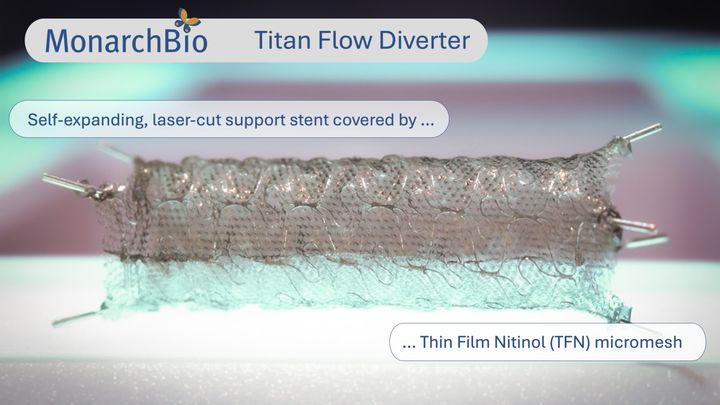
MonarchBio is a medical device company whose lead product, the Titan stent, is designed to treat brain aneurysms, dangerous bulges that form in the walls of blood vessels in the brain and can rupture if left untreated. Brain aneurysms are surprisingly common, affecting up to 5% of all adults. Over the past 30 years, treatment has advanced significantly, moving away from open brain surgery toward minimally-invasive procedures that are safer and faster to recover from. Despite these advancements, certain types of aneurysms, particularly large and giant aneurysms located on a major artery at the base of the brain called the internal carotid artery, remain very difficult to treat, with poor long-term outcomes and a high likelihood that patients will need additional procedures. The Titan takes a fundamentally different approach from currently-available devices, using an advanced ultra-thin metal mesh made from a material called Thin Film Nitinol (TFN) to seal off aneurysms faster and more reliably than existing options.
A 74-Year-Old Woman Loses Her Voice and Strength
A.V. was a 74-year-old woman with a history of high blood pressure and high cholesterol, but otherwise in good health. About a year before her diagnosis, she began experiencing troubling and recurring neurological symptoms: she struggled to find words and speak clearly, had difficulty controlling the muscles in her mouth (aphasia and dysarthria), and noticed growing weakness on the entire right side of her body, affecting both her arm and leg (brachiocrural weakness). After these symptoms persisted, her doctors ordered an MRI, which revealed the cause to be a giant aneurysm on the left internal carotid artery, one of the brain’s main blood supply vessels. The aneurysm had grown large enough to physically compress surrounding brain structures on the left side, explaining her symptoms.
The Best Available Treatment Falls Short
Given the severity of her condition, her medical team decided to treat the aneurysm using Medtronic’s Pipeline stent, currently considered the gold standard device for this type of brain aneurysm. The Pipeline is a flow diverter, meaning it works by redirecting blood flow away from the aneurysm so that the bulge gradually clots and seals itself off. The procedure went smoothly, with the device successfully placed in her artery to cover the opening of the aneurysm. She was sent home and monitored closely. While her symptoms improved slightly at first, by around the six-month mark she was getting worse again. At eight months, her doctors performed repeat imaging and made a concerning discovery: the aneurysm was still active and had actually grown larger despite the Pipeline device being in place.
When Standard Care Isn’t Enough, a New Device Offers a Second Chance
With the patient’s condition deteriorating, her care team made the decision to attempt a rescue procedure using MonarchBio’s Titan stent. A 20mm Titan stent was inserted through the existing Pipeline device already in her artery — a technique known as stent-in-stent — and precisely positioned to cover the opening of the aneurysm. The procedure was completed successfully, and she was transferred to the neurological intensive care unit for close monitoring. The results were swift and striking. Within just 24 hours, she began showing noticeable improvement in her neurological symptoms. She was well enough to go home just three days after the procedure.
Four Weeks Later: Full Recovery and a Fully Sealed Aneurysm
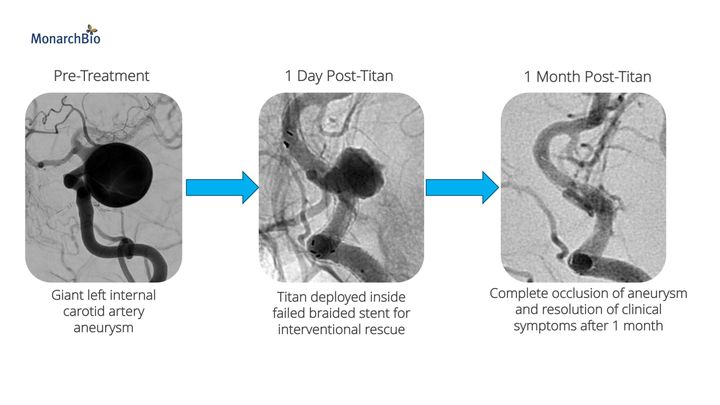
A month after the procedure, A.V. returned to the clinic for follow-up imaging. The results were remarkable. All of her neurological symptoms had completely resolved. Her speech had returned to normal, and full strength had come back to both her arm and leg. Imaging confirmed what her recovery suggested. The aneurysm had been completely sealed off. Additional MRI scans showed that a protective clot had formed inside the aneurysm sac, a sign that the vessel wall was healing.
A Result Never Before Seen in the Medical Literature
As far as MonarchBio leadership can determine, no case has ever been reported in which a giant brain aneurysm closed this quickly after a previous treatment had already failed. The speed of this outcome is remarkable on its own, but it is made all the more significant by the fact that this was a large, complex aneurysm that had already resisted treatment with one of the most widely used and trusted devices in the field.
What This Means for Patients and the Future of Aneurysm Treatment
These findings suggest that the Titan stent may offer meaningful advantages over current standard-of-care devices for patients with difficult-to-treat brain aneurysms, and provide early validation of MonarchBio’s TFN technology platform as a potential step forward in the field.
MonarchBio was founded on the belief that we could leverage our thin film nitinol (TFN) technology platform to build the world’s fastest and most reliable stent for treating intracranial aneurysms. Initial results from our first-in-human trial of the Titan support this hypothesis and we look forward to sharing additional clinical data as it becomes available.”
— Colin Kealey, M.D., CEO, MonarchBio, Inc.
About MonarchBio
MonarchBio is a Los Angeles-based life sciences company focused on development and commercialization of its unique Thin Film Nitinol (TFN) biomaterial platform for use in advanced medical device, biotechnology, and regenerative medicine products. TFN is fabricated in-house using techniques adapted from the electronics industry. An ultra-pure film of nitinol, 1-20 micrometers thick (for comparison, the average human hair is approximately 50 micrometers thick), is deposited on a silicon wafer with a specially designed micropatterned surface. When the film is removed from the wafer, it maintains the shape or pattern on the wafer surface. MonarchBio has twenty-one issued or allowed U.S. patents, in addition to having exclusively licensed a portfolio of patents from UCLA and the Fred Hutchinson Cancer Research Center related to various applications of TFN technology. MonarchBio was formed in 2011 and in 2012, MonarchBio acquired a portfolio of patents and related trade secrets covering the fabrication of Thin-Film Nitinol (TFN) from TiNi Alloy Company.
MonarchBio’s lead product under development – the Titan Flow Diverter™ – is a TFN-covered stent, which offers potentially superior and more rapid occlusion of cerebral aneurysms compared with current leading neurovascular products in the market. The unique properties of TFN allow for the fabrication of flow diverters that can be compressed and inserted through very small catheters into blood vessels and positioned over the neck of the aneurysm. The Titan Flow Diverter uses an omni-directional thin film mesh that covers a custom neurovascular support stent. Once deployed, the Titan Flow Diverter serves a dual purpose: (1) it restricts blood flow into the aneurysm, which in turn causes the aneurysm to stagnate, and (2) it acts as a scaffold for rapid re-endothelization of the vessel wall. MonarchBio has completed preclinical animal and recent human simulator testing at Mayo Clinic’s campus in Rochester, Minnesota. Approximately 30,000 cerebral aneurysms rupture annually in the United States and the market for flow diverting stents is approximately $300 million annually.
The second product in its pipeline, the Engineered Lymph Node™ (ELN), is a TFN-based device for local delivery of cell therapies treating solid tumors. The ELN provides a scaffold for delivering ultra-high densities of anti-cancer lymphocytes, including CAR-T, TCR and NK cells, directly to the tumor. Once in place, the ELN provides an immunostimulatory microenvironment that fosters rapid expansion of the anti-cancer lymphocytes and a robust antitumor effect in multiple preclinical models. Work at Fred Hutchinson Cancer Research Center (Seattle, Washington) in a mouse model of metastatic ovarian cancer using ROR1-directed CAR-T cells delivered on the ELN showed a long-term survival of 70% as compared to 100% mortality after 65 days in mice receiving intravenous or intratumoral injections of the CAR-T cells (p < 0.001).
For more information, please visit www.monarch-bio.com.
:format(webp))
:format(webp))
:format(webp))