
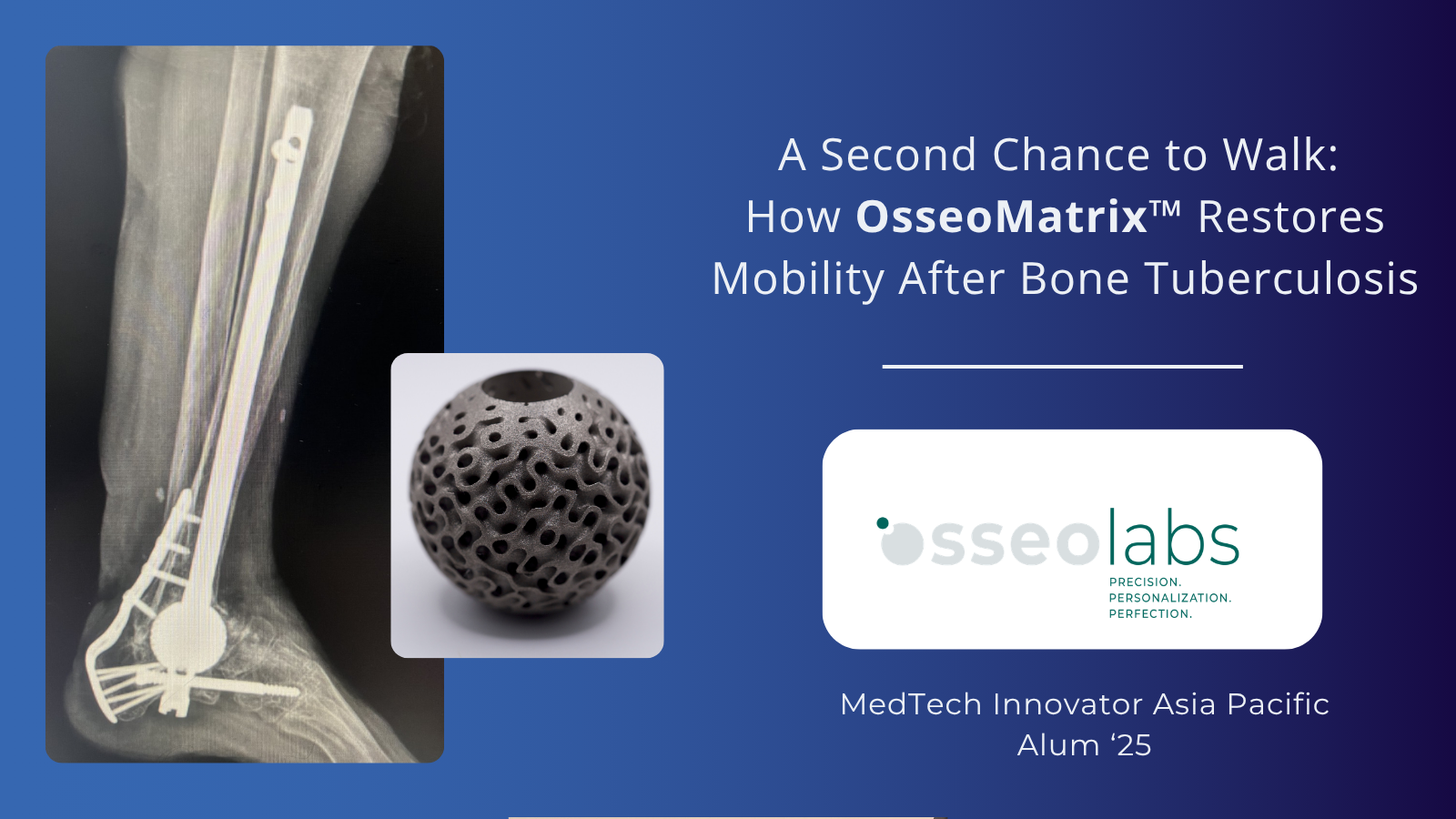
A Second Chance to Walk: How OsseoMatrix™ Restores Mobility After Bone Tuberculosis
Patient Stories: How MedTech Innovator alumni are transforming lives
At MedTech Innovator we empower healthtech companies to bring groundbreaking solutions to patients in need. Our Patient Stories series highlights the real-world clinical impact of the companies we support—showcasing how their technologies are transforming patient care, improving outcomes, and advancing healthcare. OsseoLabs was a participant in the 2025 MedTech Innovator Asia Pacific cohort.
Modern orthopedic reconstruction has long relied on solid metal implants secured with screws to stabilize damaged or missing bone. While these devices offer immediate mechanical support, they often function as passive structures, providing stability without actively participating in the body’s natural healing processes. Over time, this limitation can lead to inadequate biological integration, implant loosening, delayed healing, or even the need for revision surgery, particularly in patients with extensive bone loss or compromised bone quality.
Long-term success in bone reconstruction depends on more than mechanical fixation alone. True durability comes from biological integration, where bone tissue grows into and around the implant. This process creates a more natural connection between the implant and the body, improving load distribution, enhancing structural stability, and ultimately supporting better recovery outcomes.
Surgeons frequently face complex clinical scenarios. Large bone defects, weakened bone structure, and high load-bearing demands present significant challenges. OsseoMatrix™, the biomimetic porous technology developed by OsseoLabs, addresses this critical gap by introducing a porous, biomimetic architecture designed to encourage bone ingrowth while preserving structural integrity. By increasing surface area and enabling biological interaction, it offers a more balanced approach, one that supports both immediate stability and long-term integration.
Living with Progressive Bone Loss
A middle-aged woman, responsible for supporting her family, found her life upended by a diagnosis of bone tuberculosis affecting the ankle and foot. Bone tuberculosis is a severe form of extrapulmonary tuberculosis. While tuberculosis affects approximately 10 million people globally each year, only 1–3% of cases involve the musculoskeletal system. Within this subset, foot and ankle involvement is relatively rare but particularly complex to treat. These cases often result in significant bone destruction, instability, and long-term disability, especially when conventional reconstruction methods fail.
In our patient, this condition led to progressive bone destruction and joint instability. As the disease advanced, she experienced severe chronic pain and increasing difficulty walking, making it challenging to maintain her livelihood and care for her household. Despite undergoing five prior surgeries, including screw fixation and cement-based reconstruction, her symptoms persisted. Her mobility remained significantly impaired, and her quality of life continued to decline.
Technology in Action
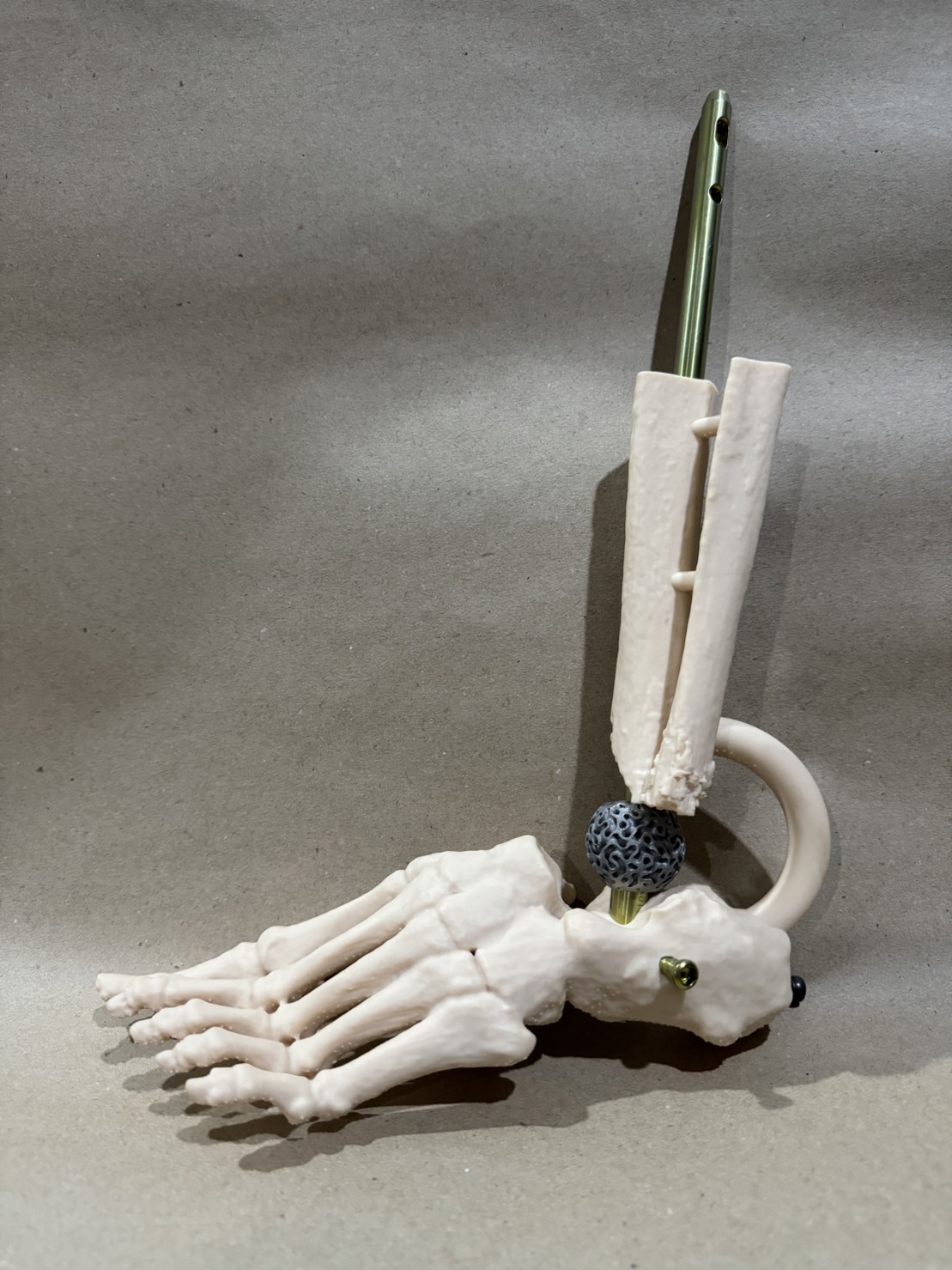
Recognizing the limits of traditional approaches, Dr. Jaruat Jampa and the clinical team of Trang Hospital, in collaboration with OsseoLabs, developed a patient-specific solution tailored to the patient’s anatomy and functional needs.
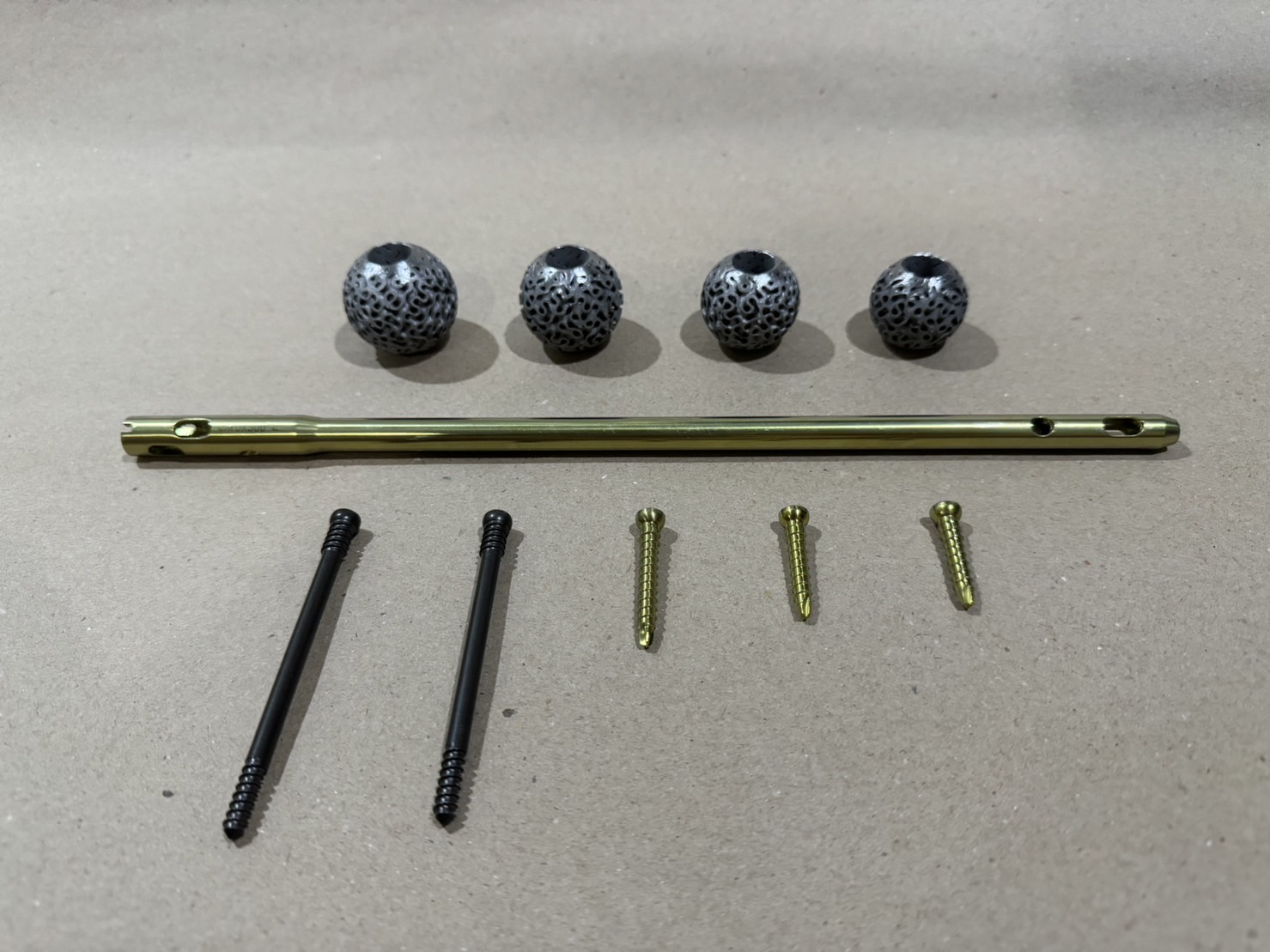
The resulting implant, incorporating OsseoMatrix™ technology, features a spherical design for optimal defect fit and load distribution. At its core is a 3D-printed Triply Periodic Minimal Surface (TPMS) porous structure that mimics natural bone, promoting tissue ingrowth and long-term biological fixation.
Research on Gyroid TPMS structures demonstrates several key advantages:
- High interconnected porosity (50–90%), allowing efficient transport of nutrients and fluids essential for healing
- Enhanced fluid permeability, supporting better biological interaction between implant and surrounding tissue
- Improved biocompatibility, compared to conventional lattice structures
- Mechanical stimulation within optimal ranges, with up to 70% of the structure promoting t
 issue growth depending on design parameters
This combination of properties transforms the implant from a passive support device into an active participant in the healing process. Advanced TPMS-based design also enables precise control over pore size, density, and mechanical behavior allowing the implant to more closely match the characteristics of natural bone, balancing strength with biological compatibility.
Restoring Mobility, Restoring Life
Within 10 months post-operation, the patient had returned to walking daily. The patient’s recovery marked not just a clinical success, but a profound personal turning point.
I had already gone through multiple surgeries, and each time I hoped it would help—but the pain and instability never went away. At one point, I truly believed I might never be able to walk normally again. I had started to give up.
After receiving this implant, everything changed. Gradually, I was able to stand, walk, and return to my daily life. I work as a hairstylist, and being on my feet is essential for my job. Being able to go back to work meant everything to me.
I’m incredibly happy and grateful. This treatment gave me my life back. I’m deeply thankful to the doctor and the team who created this innovation.
A Shift Toward Smarter Reconstruction
This case reflects a broader shift in orthopedic care, from purely mechanical implants to biologically integrated solutions that work with the body.
OsseoLabs embodies this evolution, with OsseoMatrix™ technology transforming implants into active environments for healing and enabling more durable recovery, restored function, and improved quality of life.
About OsseoLabs
OsseoLabs is an AI-driven medical technology company developing the next generation of personalized surgical implants. The company’s proprietary platform integrates OsseoVision™, an AI-powered surgical planning system, with advanced 3D-printed titanium and bioresorbable magnesium implants — each device designed, engineered, and manufactured to match the individual patient’s anatomy.
Founded in 2022 and headquartered in Indianapolis, USA, with manufacturing operations in Thailand, OsseoLabs operates across the full digital-to-implant workflow: from CT-based surgical planning through computational design, AI automation, and additive manufacturing. The company’s platform spans cranio-maxillofacial (CMF), orthopedic trauma, and reconstructive surgery, with a portfolio of over 70 personalized implants and surgical instruments — including the world’s first personalized bioresorbable magnesium implants.
OsseoLabs holds platform-level intellectual property across four proprietary technologies: OsseoVision™ (AI surgical planning), OsseoMatrix™ (TPMS-based tunable porous scaffold architecture), LaserPulsation™ (proprietary magnesium laser powder bed fusion process), and OsseoAdapt™ (thermal microstructure engineering for bioresorbable implants). The company is named inventor on 28 patents, with IP protection spanning biomechanical engineering, material science, and additive manufacturing processes across the United States, European Union, and Asia-Pacific.
With over 300 clinical cases completed across partner hospitals, ISO 13485 certification, and distribution agreements spanning various continents, OsseoLabs has established meaningful commercial traction in the global custom implant market. The company has secured more than $4 million in non-dilutive grants and has been recognized as a Top 4 Finalist at MedTech Innovator APAC 2025 and invited into JLABS by Johnson & Johnson. Additional recognitions include the WIPO Global Awards, SelectUSA Tech APAC, and VentureBlick Super Innovator.
OsseoLabs is led by Vikram Ahuja, Ph.D., Co-founder and CEO, who was named one of the Top 25 MedTech Executives of 2025 by The Healthcare Technology. Dr. Ahuja holds a Ph.D. in Business Economics from Indiana University’s Kelley School of Business, where he serves as Visiting Professor, and is a serial entrepreneur with three prior exits.
For more information, visit www.osseolabs.com.


