
From Concept to Clinic: ResQFoam™ Marks a First-in-Human Milestone in Trauma Care
Patient Stories: How MedTech Innovator alumni are transforming lives
At MedTech Innovator we empower healthtech companies to bring groundbreaking solutions to patients in need. Our Patient Stories series highlights the real-world clinical impact of the companies we support—showcasing how their technologies are transforming patient care, improving outcomes, and advancing healthcare. Arsenal Medical was a participant in the 2024 MedTech Innovator cohort.
From Concept to Clinic: ResQFoam™ Marks a First-in-Human Milestone in Trauma Care
In trauma care, survival is often measured not in hours, but in minutes. ResQFoam™ enters this high-stakes arena with a deceptively simple idea: what if internal bleeding could be temporarily controlled from within, buying enough time to reach the operating room?
The Critical Window Before Surgery
Trauma remains one of medicine’s most difficult public health challenges. In the United States, it’s the leading cause of death for people under 46, driven by vehicle collisions, gunshot wounds, and falls.1 The numbers are even starker in military settings, where hemorrhage accounts for up to 90 percent of potentially preventable deaths.2,3 In civilian trauma, uncontrolled bleeding is the second leading cause of death after head injury, responsible for roughly 26 to 40 percent of preventable fatalities.4,5 And even among patients who make it to surgery, almost 50% percent may still die despite treatment at top trauma centers.6 Mortality from bleeding and shock has barely budged since the 1990s, even in the best-resourced hospitals.6
Much of that persistence comes down to a single, brutal problem: unlike a bleeding limb, the torso can’t be compressed from the outside, and every minute of uncontrolled internal hemorrhage narrows the margin for survival.7
Getting to patients sooner, ideally before they reach the hospital, makes a measurable difference.8,9,10 But options for managing internal bleeding outside of the operating room remain frustratingly limited. That gap between injury and surgery is exactly where ResQFoam is designed to operate, providing a temporary bridge during a critical window.
A New Approach to Internal Hemorrhage Control
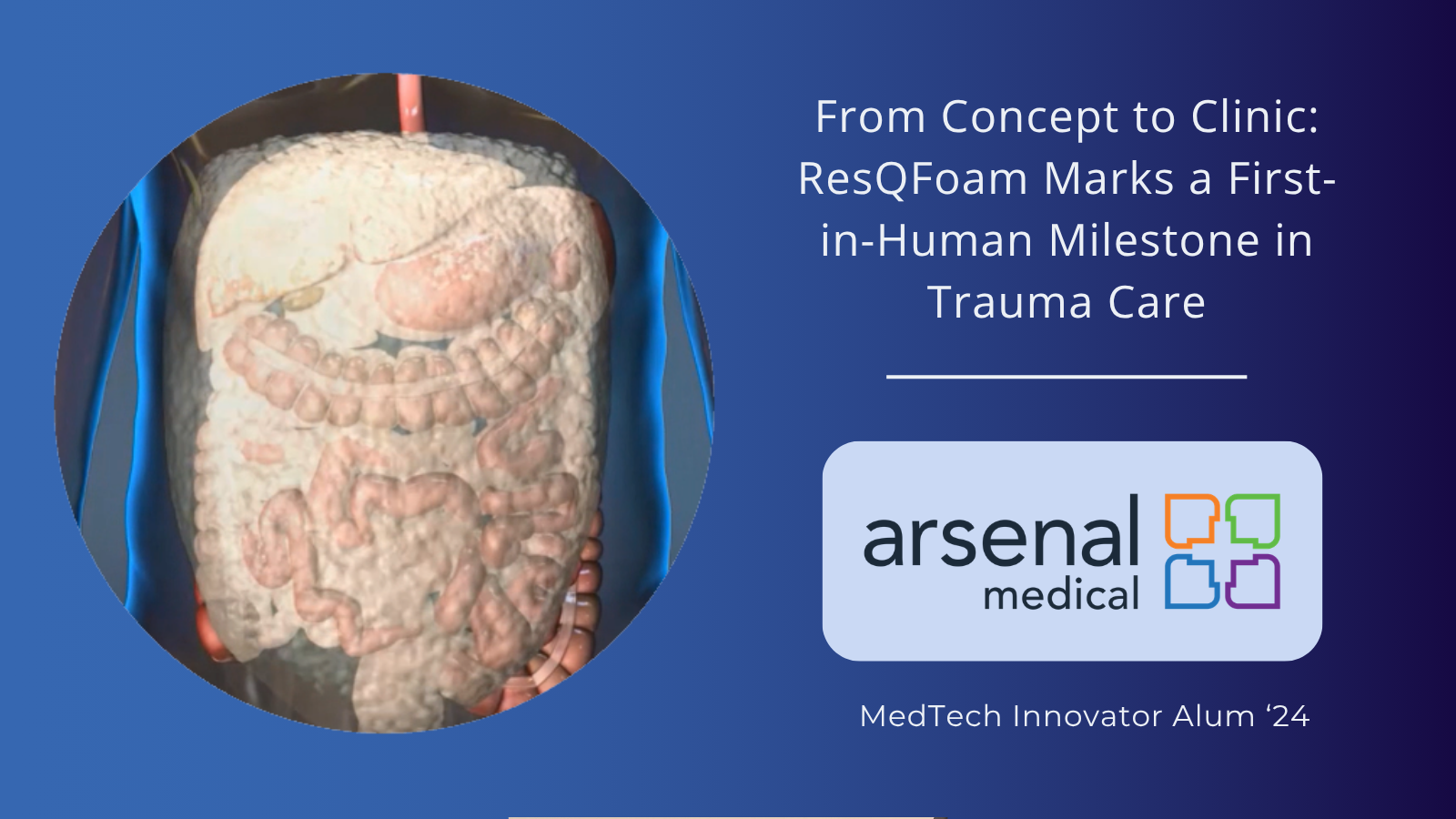
Think of ResQFoam as a human “fix-a-flat” for catastrophic internal bleeding. Delivered directly into the abdominal cavity, the material expands rapidly into a conforming foam that applies pressure, slowing hemorrhage long enough to stabilize the patient for transport. Once in the operating room, surgeons extract the foam and proceed with definitive repair of the underlying injuries.
The FDA has granted ResQFoam Breakthrough Device designation, a recognition of both its novelty and its potential to fill a critical unmet need in trauma care.
Rewriting the First Minutes of Trauma Care: First Clinical Use in Hemorrhagic Shock
The patient was a 34-year-old man, rushed into the trauma bay after a motor vehicle collision. He had no detectable blood pressure and only a faint pulse, unmistakable signs that he was teetering at the edge of survival.
As part of the REVIVE clinical trial, the team administered ResQFoam. His blood pressure and pulse improved. He was transported to the operating room, where surgeons performed definitive repair, removed the foam, and addressed the source of the bleeding. He survived and was eventually discharged from the hospital.
It saved my life, it really did,” said the ResQFoam Patient [Watch the interview now].
It was the first time ResQFoam had ever been used in a human patient.
The REVIVE trial is a single-arm study operating under FDA investigational device exemption (IDE), evaluating the technology’s safety and efficacy in patients experiencing hemorrhagic shock from intra-abdominal bleeding.
For Preston Hewgley, M.D., who serves as principal investigator on the REVIVE trial at UAB, that case reflects a reality he knows well…
Critically injured patients with uncontrolled abdominal bleeding face a survival rate of just 50%, even if they rapidly reach surgery at level 1 trauma centers. Every minute counts.”
A Shift in the Timeline of Survival
ResQFoam isn’t a substitute for surgery. It’s something more specific than that — a way to slow the clock when the body is running out of time.
In a field where minutes can change an outcome, that added time could mean the difference between death and survival. If ongoing studies support its safety and effectiveness, ResQFoam may help reshape the earliest, most fragile moments of hemorrhage management, giving clinicians a crucial buffer in situations where, until now, there simply wasn’t one.
About Arsenal Medical
Arsenal Medical is a privately held, venture-backed, clinical-stage company developing innovative biomaterials to address challenging and underserved medical problems. Its lead products target neurovascular and trauma conditions. The company was founded by academic luminaries Robert Langer and George Whitesides, together with entrepreneur-investor Carmichael Roberts, who shared a vision for how materials can transform medical devices.
References
[1] Rhee P, Joseph B, Pandit V, Aziz H, Vercruysse G, Kulvatunyou N, Friese RS. Increasing trauma deaths in the United States. Ann Surg. 2014 Jul;260(1):13–21. doi:10.1097/SLA.0000000000000600.
[2] Bellamy RF. The causes of death in conventional land warfare: implications for combat casualty care research. Mil Med. 1984;149:55–62.
[3] Eastridge BJ, Mabry RL, Seguin P, Cantrell J, Tops T, Uribe P, et al. Death on the battlefield (2001–2011): implications for the future of combat casualty care. J Trauma Acute Care Surg. 2012;73:S431–7.
[4] Tien HC, Spencer F, Tremblay LN, Rizoli SB, Brenneman FD. Preventable deaths from hemorrhage at a level I Canadian trauma center. J Trauma. 2007;62:142–6.
[5] Teixeira PGR, Inaba K, Hadjizacharia P, Brown C, Salim A, Rhee P, et al. Preventable or potentially preventable mortality at a mature trauma center. J Trauma. 2007;63:1338–46.
[6] Harvin JA, et al. Mortality after emergent trauma laparotomy: A multicenter, retrospective study. J Trauma Acute Care Surg. 2017 Sep;83(3):464–468. doi:10.1097/TA.0000000000001619.
[7] Timing of trauma deaths due to uncontrolled bleeding have not changed in three decades: A multicenter study of patients in hemorrhagic shock. Am J Surg. 2025 Dec:250:116510. doi:10.1016/j.amjsurg.2025.116510.
[8] van Oostendorp SE, Tan ECTH, Geeraedts LMG. Prehospital control of life-threatening truncal and junctional haemorrhage is the ultimate challenge in optimizing trauma care. Scand J Trauma Resusc Emerg Med. 2016;24:110.
[9] Holcomb JB. Transport Time and Preoperating Room Hemostatic Interventions are Important: Improving Outcomes after Severe Truncal Injury. Society of Critical Care Medicine. 2018.
[10] Baraniuk S, et al. Pragmatic Randomized Optimal Platelet and Plasma Ratios (PROPPR) Trial. Injury. 2014;45(9):1287–1295. doi:10.1016/j.injury.2014.06.001.


