
The 2026 MTI Index
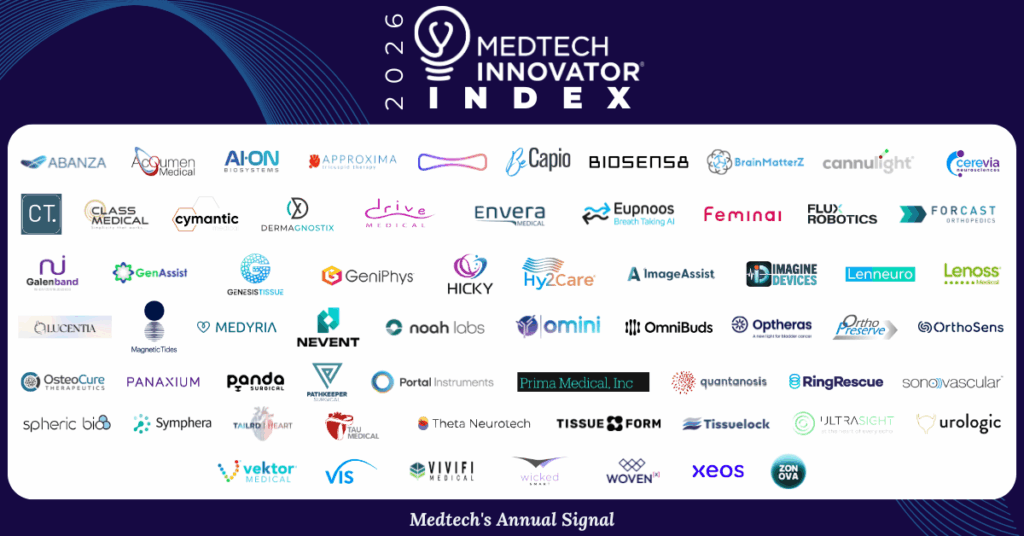
The MTI Index is a dynamic, time-banded benchmark designed to quantify the growth, survival, and commercial traction of medical technology innovation. It tracks the most rigorously vetted private medtech companies in the world as a live, scored class, beginning at the moment they earn inclusion, and continuing as long as they remain independent.
The 2026 MTI Index is the inaugural Annual Index. The 65 MTI Index Companies featured here represent the top 3.6% of more than 1,800 global applicants. It is one of the most competitive validations available in medtech, and the entry point to a permanent, evolving record of how each company performs against its peers.
What is the MTI Index?
it is a quantifiable benchmark, the MTI Index, that tracks each company’s progress against its peers from the moment of inclusion forward. Every MTI Index Company begins at a baseline score of 1,000 points. From there, the score moves with the company.
Day 0 for the 2026 MTI Index is June 1, 2026. Every company in the 2026 class starts that day at 1,000.
How Radar produces the class
Companies earn their place in the Index through Radar process, MedTech Innovator’s proprietary annual vetting process and the hardest part of the model to replicate. Radar puts every applicant in front of the audience that decides which medical technologies reach scale, with strategic interest from major device, diagnostic, and digital health manufacturers as the central signal.
That signal is the closest thing medtech has to a leading indicator of commercial success. Strategic acquirers see the entire pipeline of what their categories need next: clinically, financially, and from a reimbursement standpoint. Their attention is the hardest thing for an early-stage medtech company to earn. Most never get it. Radar is built specifically to identify the companies that do, years before such interest would surface through conventional channels.
To validate that strategic interest in context, every application is reviewed by a panel that mirrors the full set of stakeholders any medical technology company must convince to reach the market. More than 260 subject matter experts contribute to that review each year, including:
- Strategic acquirers from leading device, diagnostic, and digital health manufacturers
- Active medtech investors
- Practicing clinicians across relevant specialties
- Officials from the U.S. Food and Drug Administration (FDA), the Centers for Medicare & Medicaid Services (CMS), and the American Medical Association (AMA)
- Regulatory, reimbursement, and commercialization consultants
- Representatives from professional medical societies and patient advocacy organizations
Together, this panel represents every category of decision-maker who determines whether a medical technology gets cleared, reimbursed, adopted, acquired, and brought to scale. A company makes the MTI Index by clearing that multi-stakeholder bar on its own merit. The strategic interest it draws in the process is the strongest early indicator of where the next generation of clinically relevant, commercially viable medtech is being built.
The MedTech Maturity Index methodology
The MTI Index exists to answer a question that investors, health systems, and journalists ask constantly: of all the companies that cleared the bar, which ones are actually moving?
After initial inclusion, companies hit verifiable milestones, or Inflection Points. These are grouped into categories, each weighted to reflect its strategic significance:
- Capital events
- Regulatory milestones
- Clinical milestones
- Product development milestones
- Commercial traction
- Reimbursement progress
- External validation
Public events such as FDA actions, clinical trial registrations, society endorsements, are captured automatically. For private milestones, companies update their own Inflection Points through the Index.
Analyzing the 2026 MTI Index
Below is an analysis of the 2026 MTI Index. It reveals where medtech innovation is concentrated, who is building it, and the themes shaping the next generation of medical devices, diagnostics, and digital health platforms.
A class defined by extreme selectivity
The Index begins with a funnel that few evaluation processes can match. Of approximately 1,800 applicants, 200 reached the pitching stage at the Radar Forum and virtual Radar sessions in April. From those, 65 earned a place on the Index, meaning roughly one in three pitching companies qualified, and one in 28 applicants overall.
For context on what that selection produces over time: companies that have previously cleared this bar have collectively raised $12 billion in follow-on funding, brought more than 500 products to market, and generated 63 acquisitions. The 2026 MTI Index is, in effect, a leading indicator of the companies most likely to define those metrics over the next decade.
Cardiovascular leads by a wide margin
The category breakdown is one of the clearest signals in the data. Cardiovascular and interventional companies make up 19 of the 65 MTI Index Companies, nearly 30% of the entire Index, and the largest cluster by a meaningful margin. Surgical and orthopedic follows at 11, then diagnostics and monitoring at 10, neurotech at 9, and GI/urology and regenerative medicine tied at 8 each.
The cardiovascular concentration tracks with where strategic capital and acquirer interest have been most active over the past several cycles. It also reflects the maturity of the underlying technology stack: AI-powered imaging interpretation, structural heart device innovation, electrophysiology mapping, and minimally invasive interventional tooling are all converging at the same time. Companies like Vektor Medical, UltraSight, Noah Labs, and Spheric Bio illustrate how computational and device innovation are now inseparable in this space.
Neurotech, while smaller in absolute count, deserves a second look. Nine MTI Index Companies span brain-computer interfaces, neuromodulation, and neurodiagnostics. That is a substantial concentration in a category that was a fraction of this size five years ago.
A genuinely global Index
The 2026 Index spans 16 countries and 18 U.S. states, with 28 of the 65 MTI Index Companies (43%) headquartered outside the United States. That international density is notable in a sector where U.S. market entry has historically dominated startup geography. A few national stories stand out:
Israel placed four companies on the Index (Feminai, BeCapio, Urologic Health, Pathkeeper Surgical), continuing its outsized footprint in surgical and diagnostic innovation. Ireland, with a population smaller than many U.S. metros, produced three (Galenband, Cymantic Medical, Class Medical). Germany also contributed three (Noah Labs, Dermagnostix, Symphera), and the United Kingdom contributed four (Chambertech, Eupnoos, Panda Surgical, Zonova). The Netherlands, Switzerland, and Canada each placed two.
The geographic spread underscores a shift worth covering: the most investable medtech companies are increasingly being built in clinical and engineering ecosystems outside the traditional U.S. coastal hubs, and they are arriving at the U.S. market via independent vetting platforms like the MTI Index rather than relocating.
Within the U.S., the map is concentrated
Among the 37 U.S. MTI Index Companies, Massachusetts leads with six. Five of them sit in Cambridge alone (Spheric Bio, UltraSight, BioSens8, Axoft, and Portal Instruments). Cambridge’s continued dominance as a medtech node, particularly for early-stage device and brain-interface work, is one of the more visible patterns in the Index.
California and Texas each placed five companies, with California’s clustered around the Bay Area and Southern California, and Texas spread across Austin, Houston, Plano, and McKinney. Colorado placed three. Notably absent from the leaderboard: New York, with just one company (Lucentia).
Built for the de-risking moment
The 2026 MTI Index is heavily weighted toward the stages where independent validation matters most. Two-thirds of the MTI Index Companies (43 of 65) sit at pre-seed or seed. Eighty-two percent are at Series A or earlier. Nine have reached Series B or later, including Portal Instruments and Tau Medical at Series C, and Dermagnostix actively raising Series C.
The active deal-flow signal is just as notable: roughly 57% of MTI Index Companies are in market raising capital now. For investors using the Index as a sourcing tool, that means more than a third of the 2026 Index is reachable for participation in an open round.
The stage mix also reveals category-specific dynamics. Neurotech is the most early-stage cluster, with six of nine MTI Index Companies at pre-seed. That signals that brain-computer interfaces, neuromodulation, and neurodiagnostics remain a frontier with significant runway before clinical scale. Cardiovascular is the most stage-diverse, spanning every tier from pre-seed through Series C, which reflects the depth of the category and simultaneous activity at both research and commercial stages. Regenerative medicine is bimodal: half the companies are pre-seed, while the other half is already at Series A or beyond, with little in between.
Together, the stage and category data point to an Index designed to surface the highest-conviction early-stage companies while still validating clinical-stage maturity, with category weighting that tracks where strategic capital is actively moving.
Themes shaping the 2026 MTI Index
A handful of cross-cutting themes recur across categories and geographies among the 2026 MTI Index Companies:
AI as infrastructure, not pitch deck. Computational platforms thread through nearly every category: Vektor Medical and Quantanosis.ai in mapping and diagnostics, UltraSight and ImageAssist in imaging, Noah Labs in heart failure, Eupnoos in respiratory monitoring, OmniBuds in wearable sensing. The 2026 Index reflects a shift from “AI medtech” as a category to AI as the default substrate underneath devices and diagnostics.
Women’s health visibility. Feminai (women’s diagnostics) and Urologic Health (pelvic floor) reflect a continued, if still modest, growth in companies addressing historically under-resourced clinical areas.
Regenerative medicine moves toward the clinic. Eight MTI Index Companies in regenerative medicine and wound care, including GenesisTissue, OsteoCure Therapeutics, TissueForm, and HY2Care, suggest the category is shifting from research to viable commercial pathways, particularly in orthopedic and soft-tissue applications.
Heart and brain, together. The Heart and Brain Health Accelerator track, run in collaboration with American Heart Association Ventures and Studio Red, will support up to eight MTI Index Companies inside the cohort and reflects an explicit institutional bet that cardiovascular and neurological innovation are converging clinically and commercially.
The specialty tracks and what they signal
Beyond the main accelerator, two specialty tracks are running inside the 2026 program. The Heart and Brain Health Accelerator (up to eight MTI Index Companies, with AHA Ventures and Studio Red) and the MTI/ASPS Plastic Surgery Accelerator (five MTI Index Companies, with the American Society of Plastic Surgeons) embed clinical society partners directly into the mentorship and showcase pipeline.
For journalists tracking how clinical specialty societies are shaping innovation pipelines, these partnerships are worth watching. They represent a model in which professional organizations move from passive endorsement to active sourcing and de-risking of the technologies that will shape their members’ practices.
What comes next
The 2026 MTI Index is the first of many. Additional MTI Indexes will follow, each with its own baseline and running ledger of Inflection Points. Over time, those Indexes will form a longitudinal record of where strategic interest concentrated in any given year, which companies moved fastest after inclusion, and how that movement compared to broader medtech norms.
We will report back on the 2026 MTI Index Companies on a periodic basis, highlighting score movement, category trends, and the Inflection Points that defined the cycle.
Quarterly updates on cohort performance, category trends, and the Inflection Points moving the most scores.
Explore the full 2026 MTI Index below. Each company profile includes clinical category, headquarters, and key data points. Filter by category or geography, or browse the full cohort.